Monday, 14 July 2014

Savvy Sewing Savings

Let's face it, sewing isn't always cheap, so I am always trying to think of ways to get the most out of each piece of fabric & every last inch of thread.
Here are just a couple of hints that I use to ensure I maximise my use of all that I purchase (especially as there are times when I need a particular piece of fabric or thread colour for a project & then have the left overs just sitting there.)

Utilizing Partly Used Thread Reels & Bobbins


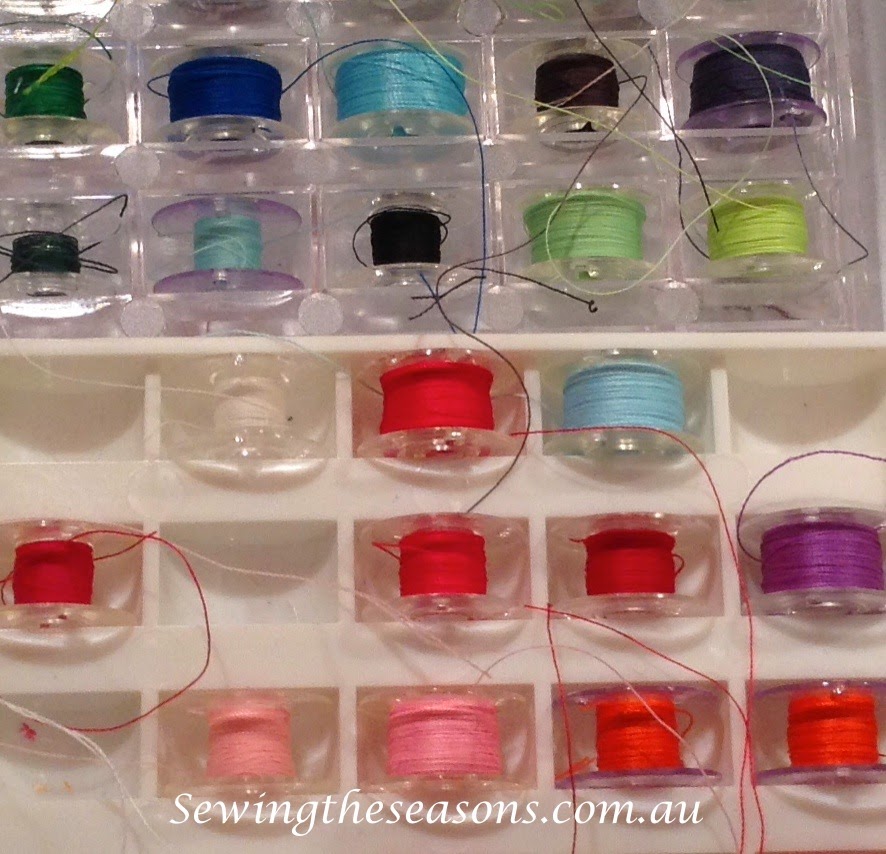
Over time my bobbin box
& thread holders end up with 
partly used bobbins & reels
of thread.


Piecing multi-coloured quilts is an ideal time to use up these part reels & bobbins.
 Yes, it does mean changing the bobbin & top thread more frequently, but it sure gets through the build up! It also means I can use complete reels for special projects or items where colour/thread match is important. 
For the reels & bobbins with very short amounts of thread left on them, I keep those for hand stitching bindings, or sewing up some of the baby balls & soft toys I make.

Utilizing Fabric Leftovers

I have baskets under my ironing board - one for small scraps (tutorial using scraps coming soon) & one for selvedges. For ideas on how to use selvedges, check out my tutorial on  
When cutting striped fabric for runners or other projects,  I found I was collecting narrow strips of pattern between each piece for the runners. 
 After cutting the runners, I have a collection of strips & selvedge pieces.
 
 I keep these strips in a container & have found several uses for them over time. Stay tuned for ways to use these strips in coming posts. 
 
Any selvedge with at least an 1" of pattern attached goes into the selvedge basket.
If there are only narrow pieces of selvedge (depends on the pattern width of each fabric design), I then trim these into narrow strips & use them to attach my business cards/price tags for items being sold at markets.
 Maybe you have some other tips for utilizing threads & fabrics? I would love to hear them.


Tuesday, 1 July 2014

Knitted Scrubbies

I've been so enjoying knitting the cotton cloths I posted the other week, I wanted to see what else I could knit as gifts. When I googled knitted scrubbies, I found a pattern for The Tribble. I had a go at one, then also checked out what other knitters had done with The Tribble.

After playing around with a few of the suggestions, I settled back on the original Tribble pattern, however, I count the number of rows needed for each one rather than measuring each time.

I wanted to clarify a couple of the terms used in the pattern and found Knitting Help easy to use, not only clear instructions but helpful video links as well.

As you can see, I've already knitted up quite a few, they are quick & easy, I've made a couple each night & feeling rather pleased I am on track with my Christmas gifts ahead of schedule!

I  use 5mm needles, cast on 18 stitches & knit 50 rows. I like to knit into the back for the first row to give a neat edge to my work. Make sure to leave the long threads as suggested in The Tribble pattern to use for sewing up. I cast off so that the threads are on the same side of the knitted piece.

After the first couple, I found I preferred to run a thread round the edge of each side & gather up the scrubbie then sew round again for strength before ending thread off.

These would also be ideal for removing make up or washing your face as the cotton is so soft. I am considering trying some in acrylic for that 'scrubbie' effect for dirty dishes.

Here's a few photos of my knitting & construction.

 Knitted piece 18 stitches, 50 rows, ends to stitch up on same side

       Stitching up the ends                                                                      Run thread round edge stitches   


 Gather up other edge                                                                                       Secure threads & knot off


                                            Flatten out finished scrubbie (tribble) 

Wednesday, 25 June 2014

Urban Stitches - a fun day of stitching!

Looking for a fun day out? Love stitching? New to stitching but want some encouragement & advice? Then I would highly recommend you consider attending Urban Stitches.


Last year Sam (she's got a knack for finding great ideas & new opportunities & I am so blessed to have her as a friend & business partner) discovered the team from Urban Stitches were heading north to Sydney so we booked in, not exactly sure what the day would bring, but let me say it was a FANTASTIC day!

We headed into the Novatel at Darling Harbour where we were greeted by Rosalie Quinlan, Melly (Melly & Me) & Jodie (Ric Rac)as well as Erica from Under The Mulberry Tree.

Each person was given a goodie bag filled with stitching goodness (forgot to get a photo) including kits with all that was needed to complete them, some scissors, Cosmo threads, a stitching guide & magazine as well as Parlan & other goodies. I particularly liked the fact that not only were the patterns in our bags but also the materials to make each one - a real bonus.

Here's the patterns that were in our goodie bag last year.

We could shop if we wanted at Under The Mulberry Tree, sit and stitch or simply chat and soak up the day as well as be inspired by samples of finished patterns from each of the girls. I was lucky enough to win one of Melly's books in the lucky door prize as well.

Rosalie, Melly & Jodie wandered round to each table during the day, happy to chat & share tips for better stitching or show some new techniques.
Here I am with Rosalie.
Our table had so much fun (still not owning up to being the cause of the burnt wool smell.......). 
If you were unsure about coming & on your own, don't worry, people were really friendly, we got to share our table with a lovely lady Margaret who had come down from Port Macquarie for the day - we loved adopting her as our table buddy!
Sam & I both started working on Rosalie's pattern on the day but it was a toss up between all the choices on offer.
Morning & afternoon tea as well as a delicious buffet lunch were included in the day. 
The day was a key part of my rediscovery of the joy of stitching, stretching my creative processes & I have had so much fun finishing each of the projects. I set myself a challenge to adapt some of the projects to suit my home & yes, the laundry stitching hangs in my laundry, promised Jodie it would & it does!
This year the Sydney one is at the Novatel in Parramatta on the first weekend in September.
Sam & I have been gathering a group of friends for the Saturday, we are really looking forward to seeing what goodies there will be this year. 
I would highly recommend the day whatever your level of stitching experience or expertise.


(Please note I have not been paid to promote this day, just wanted to share the fun & encourage people to consider attending.)

Friday, 13 June 2014

A Night with Camille

 Last night was a special night as we got the opportunity to meet the talented and gorgeous Camille Roskelley presenting a trunk show of her quilts.
 When I started my blogging journey a few months ago, Camille's blog Simplify was one of the first I started following as I love the simplicity, clarity and colours she uses. I also follow her on facebook at Thimble Blossoms
Kim & Dave from Kim Bradley Creations hosted the night at their store, lucky for me it's my local patchwork store!
Camille not only showed us many of her quilts, she talked about the 'back' story as to why each one was designed, how she & her mum Bonnie get to work together to design their fabric ranges (Bonnie & Camille) for Moda and some of the design process.
It was such a great night as Camille shared with us, I think that the pictures will tell the story best. I also got the chance to sit and chat with her friend Holly who came with Camille on the trip.


 A couple of Camille's mini quilts which are seriously begging me to try them.
 This quilt is gorgeous, like a timeline of creations with blocks from many of Camille's quilts and featuring many of her fabrics.
 Here I am with Camille and Holly (can you tell I was just a tiny, tiny, whole lot excited?)
 I have had the opportunity to attend trunk shows when travelling in America but they have never been as small and up close & personal as last night, usually I'm one of hundreds or more watching the designer on a screen you are so far away. Camille was so generous of her time, willing to answer questions & spend time chatting at the end, so glad I got to attend.

Sunday, 1 June 2014

Snazzy Selvedge Storage


I have been collecting selvedges for quite some time now as you can see from this overflowing basket. Over the years I have struggled when throwing out scraps & selvedges but decided one day - no more - why not keep them & find some creative ways to use them. So, here is a tutorial for using selvedges to make some colourful storage containers.
The tutorial is for the oval shaped container, but the principles of construction apply to the other shapes as well.

Materials Needed:
Selvedges (need to have at least 1" of fabric on them & more effective if it's the part with the words)
Fabric to attach selvedges to (base fabric).
Wadding or pellon - I used a stiff bag lining so the containers would stand up
Fabric for lining
Equipment Needed:
Scissors
Rotary cutter & mat
Sewing machine (normal foot, 1/4" foot & walking foot when sewing with the wadding)
Iron
Needle & thread

Construction:
Audition your selvedges (if desired) = I used pink tones for oval & square container & bright bolds for the pencil tin. Can be selvedge with wording or selvedge with full colour. 
Iron selvedge pieces - can spray starch if desired.

Decide on size of finished container which guides which sized selvedge block to use in construction. The choice is yours depending on what you want to use your container for. By using squares to design the containers, you end up with a chevron pattern forming when you join the squares together.
For the oval one I made 4 x 5" squares, for the square one I made 4 x 6" squares, for the pencil tin I used a 5" x 11" rectangle. 
(Note: If you don't want to construct squares or a chevron pattern, you can simply attach the selvedges directly onto the wadding as in the pencil tin or base of each container.)

The oval bin:
Cut out 4 x 5" squares from the base fabric. If desired, draw a diagonal line on the base fabric as a guide for placing the selvedges on a consistent angle.
 Stitch selvedges on to base fabric one at a time. It is personal preference whether you leave any of the fabric showing or butt the selvedges up close together. (I couldn't resist showing the gorgeous pattern of each fabric)
Once you have sewn selvedges onto all 4 base squares, trim away excess fabric.
Layout the 4 squares to form a chevron pattern ensuring the wording of selvedge faces the same direction for each square.
Join squares with a 1/4" seam then attach the rectangular strip to the wadding with quilting- for this sized container I needed a wadding strip 5" x 18 1/2" (I quilted down seams & on the diagonal).  Then join short ends of quilted wadding with a 1/4" seam.
Mark out a base in desired shape (I used my 'bendy' blue curved ruler to mark out an oval the size of the joined strips.)
 Cut out base shape and attach selvedges directly onto the base piece, trim away the excess selvedge fabric.
Join the base and container together with a 1/4" seam, right sides together. For more detailed instructions on joining, check out my Easter Basket tutorial here.
Cut out lining base as per size used with wadding. For side lining piece, cut the same length as the quilted selvedge strip but 1/2" higher, (in this case I cut a lining piece 18 1/2" x 5 1/2". (The extra 1/2" is needed to form the trim on top when turned out)
Join the two short ends of the lining piece then attach to base shape, leaving a gap in base seam to allow turn through of stitched container.
 Place liner inside the selvedge piece RIGHT SIDES together and stitch around the top.
Turn the container through the gap, then hand stitch the gap closed. (can do a narrow machine stitch if preferred.)
As you push the lining down into the container, you will find the extra 1/2" allowed in the lining piece forms a neat trim around the top of the container. I top stitched around the edge of the trim to give a neat finish (hint-easier to sew this if you have turned the container inside out for this step)

Turn container back through and you have a snazzy selvedge storage container!

Tips for square container & pencil tin:
When I made the square container, I quilted the joined selvedge squares on the seam & down the centre of each square, so when I attached the square to the base, I made the corners the centre of each selvedge square to give the chevron effect on each side of the container. The base for the square container is a 5 1/2" square. (base for a square container will be a 1/2" smaller square the squares used to attach selvedges too which allows for seam allowance when joining the side selvedge squares into the pieced strip).
 For the pencil tin, I simply attached the selvedge strips directly onto the wadding as I was making a simple rectangular shape with no chevron effect.
I hope you find this helpful and would love to see any selvedge storage you create.

Tuesday, 27 May 2014

Knitted Cloths

When I saw some gorgeous knitted cloths on Retromummy a few weeks back, I just knew I had to make some.
I followed her link to the pattern "The Almost Lost Washcloth Pattern" found here on the Simply Notable blog, ordered some worsted cotton yarn & when it arrived yesterday got straight to knitting. I have been knitting for just shy of 50 years, & found I wanted to clarify the pattern as it's quite brief. After reading through all the comments, which helped with my questions, I decided to write a more detailed pattern. 
These cloths are quick to knit up & I'm finding it quite addictive watching the circular shape grow. If you are new to knitting, or like me, just "need to know" as much detail as possible, I hope you find the extended pattern helpful. I have included some pictures which I hope you find useful to clarify some of the terms & steps.

Materials Needed
1 pair knitting needles 5mm (U.S. size 8 / Imperial size 6)
Cotton yarn - I used Lily Sugar n Cream (1 57g/20z ball enough for 2 cloths)
1 needle big enough for cotton thread to sew up cloth

Instructions
Getting started:
Cast on 14 stitches
Knit 1 row
Forming Points:
1. Knit 4 stitches, *yarn over * (see hint), knit 8 stitches, leaving 2 stitches at end of row unknitted
2. Turn & knit back (you now have 15 stitches in total)
3. Knit 4 stitches, yarn over, knit 7 stitches, leaving 4 stitches at end of row unknitted
4. Turn & knit back (you now have 16 stitches)
5. Knit 4 stitches, yarn over, knit 6 stitches, leaving 6 stitches at end of row unknitted
6. Turn & knit back (you now have 17 stitches)
7. Knit 4 stitches,  yarn over, knit 5 stitches, leaving 8 stitches at end of row unknitted
8. Turn & knit back (you now have 18 stitches)
9. Cast off 4 stitches & knit to end of row (back to 14 stitches)
10. Turn & knit one row.
  
One point knitted (Steps 1-10)                                                    Knitting back leaving 2 stitches (step2)


Repeat Steps 1 - 10
Repeat these steps 13 times so in total you will end up with 14 points.
Note - on the 14th point, instead of step 10, turn & cast off the stitches.
When you cast off, leave a long enough piece of yarn to stitch circle together.

                                                                        Casting off

Stitching Circle
Stitch up the 'sides' together using ladder stitch.
Slip needle through loops of stitches around the circle in centre & draw up to close the circle. Finish with a double knot, weave thread back through some stitches then cut.
Weave thread trail where you cast on through stitches then cut.

 Stitching up 'sides' - ladder stitch                                                           Closing the centre circle


Hint:
*Yarn over* - bring your yarn to the front of your work so when you knit the next stitch, you will actually be forming an extra stitch.
                                                         Yarn over - bring yarn to front

 I hope these instructions help you & you have as much fun as I have had making some of these cloths. Stocking up now for myself & for presents. 
Look forward to seeing any cloths you make.